
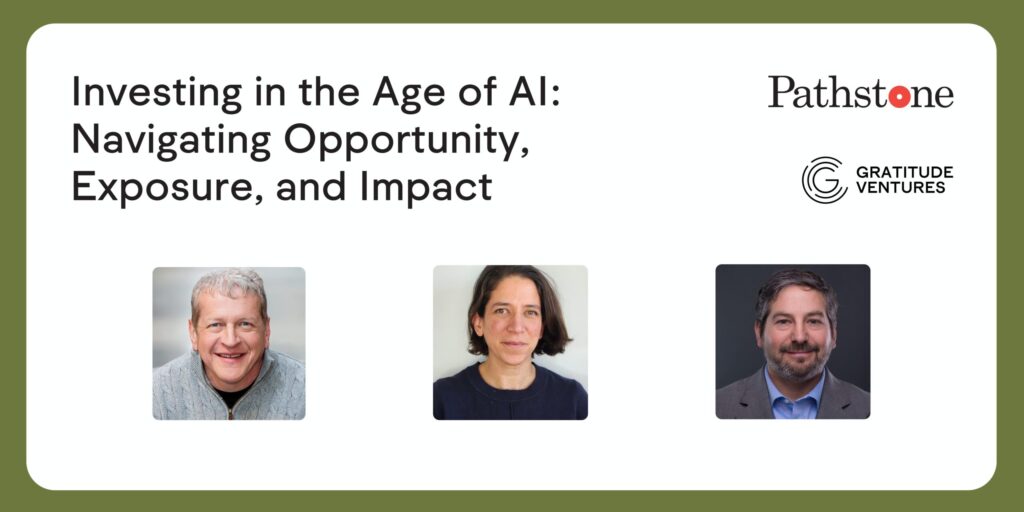
In September, Gratitude Ventures and Pathstone co-hosted a roundtable, “Investing in the Age of AI: Navigating Opportunity, Exposure, and Impact.” Craig Metrick of Pathstone moderated a conversation between Garvin Jabusch of Green Alpha Investments, who brought a portfolio manager’s view, and Meredith Benton of Whistle Stop Capital, who shared the investment research and corporate engagement perspective.
The conversation feels even more timely now, as Anthropic reportedly prepares to go public at a valuation above $1 trillion. The group covered AI exposure across public market portfolios, the hidden bet inside index weighting, how to tell good AI from bad (or whether it’s possible), and what responsible governance looks like in practice. Below are five takeaways for investors assessing AI in their public portfolios:
1. Map Your Exposure Across the AI Stack
Owning AI is no longer a yes-or-no question. Sector and style boxes have stopped mapping to earnings drivers: a chipmaker, a utility, a construction firm, and a software company can all be AI bets. Pathstone’s internal investment tool, which sorts public companies by how much of their revenue AI drives, found that almost half of the S&P 500 is AI-dominated.
Garvin emphasized the importance of understanding which layers of the AI stack investors own. Green Alpha owns both ends, from the physical layer (chips, etching machines, energy, and fabs) to the application layer (disease management, materials, agriculture, and grid optimization).
2. Treat Index Weighting as an Investment Choice
Cap-weighted index funds are often treated as the neutral default, but they follow a rule that buys more of whatever has already gone up, which in today’s market makes them AI momentum strategies.
The S&P 500 and the equal-weighted S&P 500 hold the same companies, yet they can differ by 80% in active share according to Pathstone research. That changes how investors should read tracking error, which measures how different a portfolio looks from its index, not whether it can lose money. Minimizing tracking error may now mean maximizing your exposure to AI assets.
3. Move From Hype to Understanding
Today’s AI market echoes the dot-com boom of the late 1990s: enthusiasm running ahead of understanding, with inevitable ups and downs. The more useful question for investors is not what AI will do, but how to pick companies whose leadership and governance they can trust.
Meredith’s work with the TechForward Investors Initiative identified 53 civil society criteria and back-tested them from 2020 to 2025. Several indicators were associated with lower volatility, including an executive with an explicit obligation to oversee societal relationships, public discussion of how the company makes AI decisions, and reference to an established AI governance framework. Among the indicators associated with excess returns, two ranked near the top: a precautionary ethos, or willingness to hold back before harm is proven, and an external advisory group with expertise in societal impact.
Meredith offered an important caveat that markets have not yet priced in AI governance, so these criteria signal market comfort rather than fundamentals. Adoption has risen significantly since 2020, but disclosure remains below 50%. The full TechForward database can be found here.
4. Look for Governance You Can Examine
Investors should look beyond essays and open letters for signals. Garvin’s test is to look at what companies are paid to do (i.e., what drives their revenue), not what their sustainability reports say. Proxy statements disclose how executives are compensated, and if AI guardrails aren’t in those incentives, they may not be prioritized.
The panel also called for observable markers of restraint, such as slower pacing that shows up in actual purchase commitments and capacity additions. Investors should weigh the expertise of each company’s team, board, and advisory group, and whether they understand AI risks before issues surface in the press or in regulation. Initial public offerings by frontier labs would also open new channels for direct engagement.
According to Meredith, companies responded to requests for comment on TechForward’s benchmarking at three times the usual rate, with many proactively asking to understand the criteria. In her view, investors have more voice on AI today than on any other rising issue, and the moment to use it is now.
5. Separate the Application Layer From the Enabling Layer
At the application layer, telling “good” AI from “bad” is easier. For example, look at where a company’s revenue comes from. A company in the pathway of a solution, such as disease diagnostics, crop science, grid optimization, or biopolymers, differs from one built on an extractive or engagement-maximizing business.
The enabling layer is more ambiguous. The same chip fab or accelerator trains both a drug discovery model and a surveillance model, and the panel cautioned that anyone claiming to solve this cleanly is probably selling something. Garvin’s approach is to identify who gets paid regardless of which frontier model wins.
One panelist compared AI to fire: both are general-purpose tools that can serve good or ill. In the end, the line between good and bad AI often comes down to transparency and rigor, which markets driven by visionary headlines and founder personalities still lack.
Thank You! And Join Us
The conversation left us with one question every investor can bring to their portfolio: Where in the AI stack am I exposed, how concentrated is that exposure, and what evidence gives me confidence in the companies I own?
Thank you to Pathstone for co-hosting, to Craig Metrick for moderating, and to Garvin Jabusch and Meredith Benton for a candid and rigorous discussion. To follow the research as the full database launches, visit the TechForward Investors Initiative to join its mailing list. You can also read about how benchmarks came to shape portfolios in Green Alpha’s two-part series, The Yardstick That Ate the Market, Part 1 and Part 2. And for trends shaping the case for Active vs Passive management, you can read Pathstone’s Research Note – The Long Game: Structural Change and the Case for Patient Active Management.
We’re also exploring a second session focused on AI diligence in venture capital.
If you would like to see the full recording or learn more about attending future events like this, join us by clicking below.

Join Us!
We invite you to join us in transforming capital for a thriving world. There are multiple ways to engage and learn with Gratitude Ventures. We look forward to partnering with you!
Learn More